

Rainbow Six Siege Ranked 3.0 Explained – Complete Ranked System Guide

Entry posted by Fonsed in Rainbow Six Siege
241 views
Rainbow Six Siege Ranked 3.0 Explained – A Complete Guide to the New Ranked System
Rainbow Six Siege has changed its Ranked system again, and this time the goal is much easier to understand: make your visible Rank actually mean something.
Under Ranked 2.0, the badge on your profile did not always reflect the level of opponents you were facing. A hidden MMR value handled matchmaking in the background, while your displayed Rank followed a separate progression system. That disconnect caused a lot of confusion. Players could look like they belonged in one Rank while regularly being placed into much harder or easier lobbies.
Ranked 3.0 attempts to clean that up.
Your Rank Points now play a much more direct role in matchmaking, Placement Matches have returned, squad restrictions have been tightened and Champion is split into several divisions. There is also a broader reward track that progresses simply by completing Ranked games.
The system is not complicated once you understand the pieces. The main thing to remember is that your visible Rank is no longer just a seasonal progress badge. It is meant to represent where you currently stand competitively.
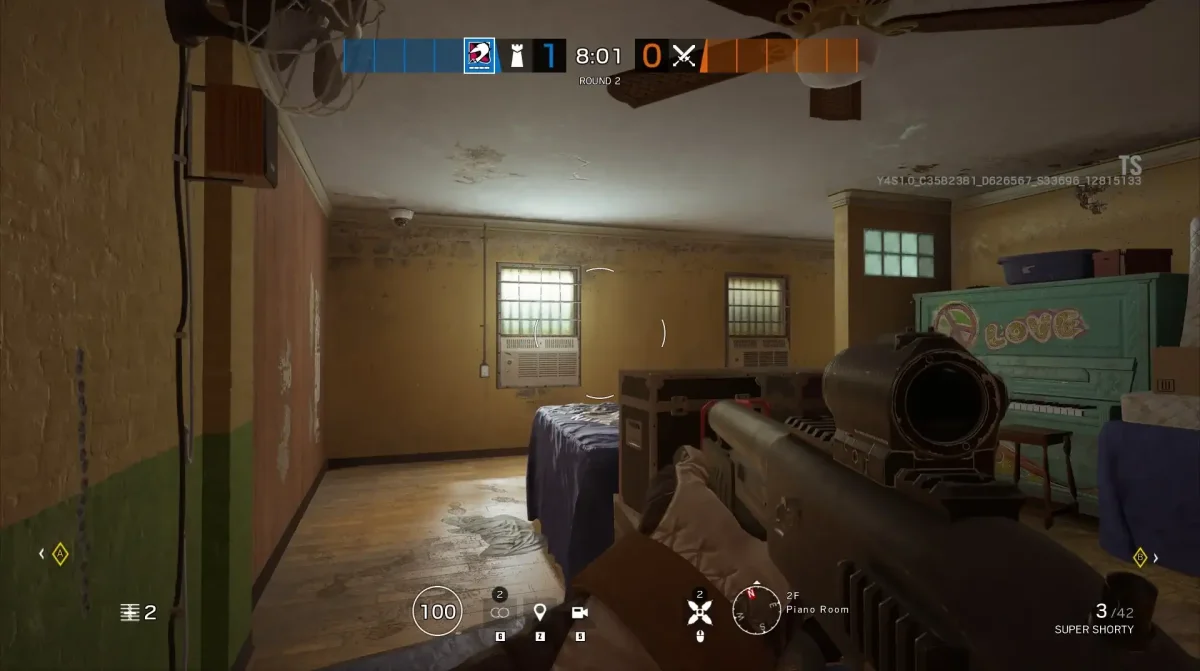
What Is Rainbow Six Siege Ranked 3.0?
Ranked 3.0 is the updated competitive system used in Rainbow Six Siege.
Instead of matching players through a separate hidden MMR rating, the system now places more importance on visible Rank and Rank Points, usually shortened to RP.
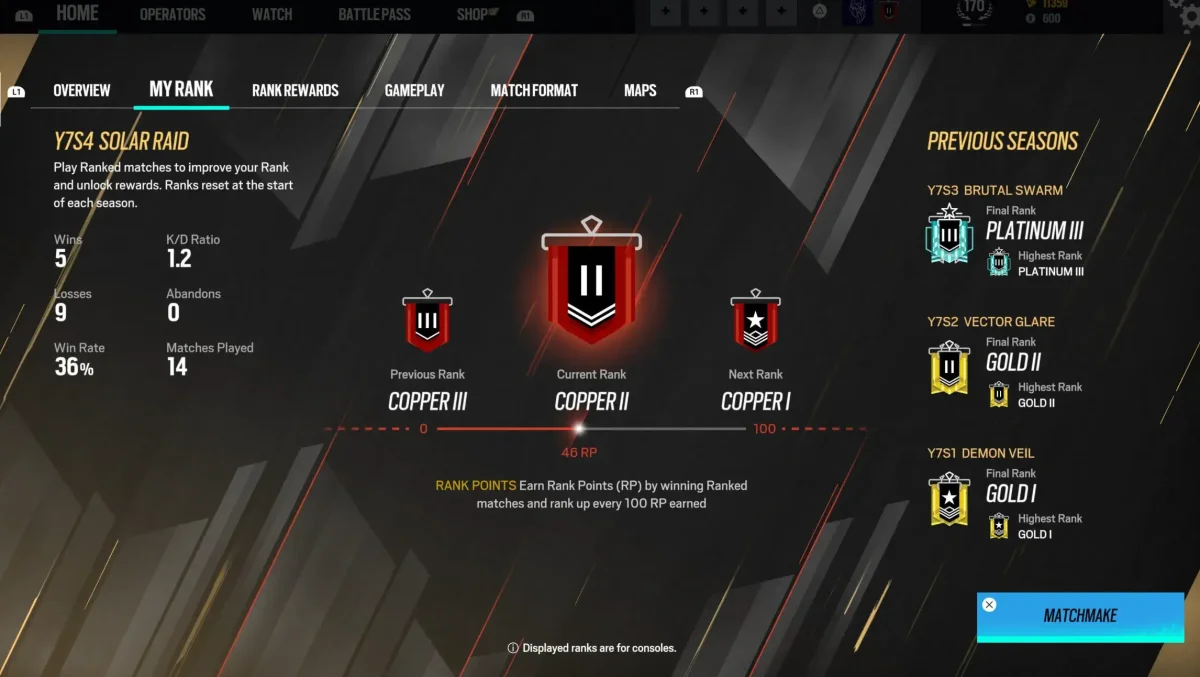
At the beginning of each season, players complete five Placement Matches. Once those games are finished, the system assigns a starting Rank. From there, wins add RP and losses remove it.
The amount gained or lost is not identical every match. Team strength matters. Beating a stronger team can be more rewarding, while losing to a weaker team can carry a larger penalty.
That is the basic structure.
Play placements, receive a Rank and then move up or down based mostly on match results and the strength of the teams involved.
Why Ubisoft Changed the Ranked System Again
Ranked 2.0 had a major clarity problem.
A player could have Gold displayed on their profile while being matched against players whose visible Ranks looked completely different. The reason was that the game was not really using those displayed Ranks to build the lobby. It was using a hidden skill number instead.
That system may have made sense behind the scenes, but it rarely felt clear to players.
People naturally assumed the Rank they could see was the Rank the game was using. When the lobby did not match that expectation, the system looked inconsistent.
Several complaints came from this:
- Visible Rank did not always match lobby difficulty
- Players could not easily tell what the game believed their real skill level was
- RP gains sometimes felt disconnected from performance
- Early-season progression felt artificial
- Starting every season at a low displayed Rank created unnecessary grinding
Ranked 3.0 is designed to make the ladder easier to read.
The badge on your profile is supposed to reflect your competitive position more directly. You may still disagree with an individual match or RP adjustment, but the overall system is less hidden than before.
The Biggest Ranked 3.0 Changes
The update touches several parts of Ranked, but a few changes matter more than the rest.
The hidden Ranked 2.0 MMR structure has been removed from Ranked matchmaking. Five Placement Matches now determine where you begin each season. RP plays a direct role in opponent selection, and large Rank gaps inside squads are more restricted.
Champion has also been expanded into five divisions rather than remaining a single final tier.
There is now more to earn from Ranked as well. Completing matches progresses a Competitive Rewards track, even when you lose.
Map bans have also been adjusted, giving the selection phase a broader mix of maps.
Taken together, these changes make Ranked feel more like a traditional competitive ladder and less like a hidden rating system covered by a seasonal progress badge.
How Placement Matches Work
Every season begins with five Placement Matches.
Your Rank is not shown immediately during this phase. The system uses those games to decide where you should start once placements are complete.
Your previous performance still matters. Placements are not a total wipe of everything the game already knows about you. A strong player does not suddenly become a complete unknown simply because a new season begins.
Previous-season results help provide context, while the five new matches adjust your starting point for the current season.
During placements:
- Your visible Rank remains hidden
- Wins and losses influence your starting position
- Previous performance still affects calibration
- RP movement is more significant
- Normal squad Rank restrictions are temporarily disabled
That last point is useful for groups of friends. Players who would normally be too far apart in Rank can still complete their placements together.
After the fifth match, the system assigns a starting Rank and normal Ranked progression begins.
Can You Place Directly Into Champion?
No.
Champion is not meant to be awarded after only five games, even to highly skilled players.
The Placement Matches can give strong players a high starting position, but Champion still needs to be earned through regular progression during the season.
That makes sense when you consider what Champion is supposed to represent. It is not simply a placement result. It is proof that a player continued winning at the top end of the ladder.
Rainbow Six Siege Ranked Tiers
The Ranked ladder contains the following main tiers:
- Copper
- Bronze
- Silver
- Gold
- Platinum
- Emerald
- Diamond
- Champion
Most of these tiers contain several divisions.
Players move through those divisions by gaining RP. Reaching the required amount pushes them into the next division, while losing enough can send them back down.
Champion Is Now Split Into Five Divisions
Champion is no longer one single tier.
Ranked 3.0 divides it into:
- Champion V
- Champion IV
- Champion III
- Champion II
- Champion I
This creates more space between players who have just reached Champion and those competing near the very top of the ladder.
Champion I contains the featured leaderboard and represents the highest level of Ranked play.
Under the older structure, two Champion players could be separated by a huge skill gap while still sharing the same general badge. The new divisions make that difference easier to see.
Reaching Champion remains impressive, but progressing through the Champion divisions shows how far a player has moved beyond simply entering the tier.
How Rank Points Work
Rank Points control your movement through the ladder.
The basic rules are simple.
Win and you gain RP.
Lose and you lose RP.
Gain enough and you advance. Lose enough and you may fall into a lower division.
The part that changes from match to match is the amount.
Ranked 3.0 does not treat every win as equal. Beating a team the system considers stronger can be worth more than beating a team ranked below you.
The same idea applies to losses.
Losing to a stronger team may carry a smaller penalty. Losing a match the system expected your team to win can cost more.
This helps the ladder react to the quality of each result rather than awarding the exact same number every time.
What Determines RP Gains and Losses?
Two things matter most:
- Whether your team won or lost
- The Rank difference between the teams
That creates a few common outcomes.
Beating a stronger team can award a larger RP gain. Beating a weaker team may award less.
Losing to a stronger team can result in a smaller loss, while losing to a weaker team may remove more RP.
The post-match screen shows the final adjustment, so you can see exactly how much your Rank changed.
You may still have matches where the number feels harsh or overly generous, but it is not based only on a fixed win-or-loss value.
The system is also considering how difficult the matchup was expected to be.
Does KDA Affect Your Rank?
Not directly.
Your kills, deaths and assists can influence whether your team wins, but the game does not award Rank simply because you finished with the highest KDA.
This is important in Siege because not every valuable player is an entry fragger.
A support player may spend the round gathering information, opening reinforced walls, watching a flank or protecting the defuser plant. A defender may deny utility, hold an important angle or keep attackers out of the site long enough for the clock to become a problem.
None of those contributions always produces a large number of kills.
A player can finish with fewer eliminations and still be one of the main reasons the team won.
Ranked progression rewards the result. Individual statistics matter only in the sense that they help create that result.
How Ranked 3.0 Matchmaking Works
Matchmaking now relies primarily on Rank Points rather than the separate hidden MMR structure used before.
The game still needs to consider practical details. It cannot build every lobby using Rank alone.
Queue time, player location, squad size and the number of available players all affect how quickly a suitable match can be found.
The system also looks at the strength of the squad as a whole.
When several players with different Ranks queue together, the squad is not always treated as a simple average. Greater weight is placed closer to the stronger players in the group.
This helps prevent one highly ranked player from lowering the apparent strength of a squad by joining several much lower-ranked teammates.
The idea is to reduce matches where one player is clearly operating far above the level of the rest of the lobby.
Ranked 3.0 Squad Restrictions
Ranked 3.0 limits how far apart teammates can be when queuing together.
For players between Copper and Emerald, squad members can generally be within three full Ranks of one another.
Diamond and Champion players face a tighter restriction of two full Ranks.
The purpose is straightforward. Ubisoft wants to reduce extreme gaps inside premade teams.
Without limits, a very strong player could queue with teammates far below their level and create lobbies that are difficult to balance fairly.
Placement Matches are the exception.
During the first five games of the season, the normal Rank restrictions are disabled. Friends can complete placements together even if their previous Ranks would normally prevent them from forming a squad.
Once placements are finished, the regular limits apply again.
How the Demotion Shield Works
The Demotion Shield is still part of Ranked 3.0.
Suppose you are close to dropping into a lower division. If you lose, the shield may stop the immediate demotion and leave you at 0 RP instead.
There is one important condition: you must have started the match above 0 RP.
If you begin the next game already sitting at 0 RP and lose again, you can be demoted.
The shield gives you one chance to recover. It does not protect your Rank forever.
That small buffer can be useful after a difficult loss, but it should not be treated as a safety net for several matches.
Once you are at 0 RP, the next game matters.
The Competitive Rewards Track
Ranked 3.0 also introduces a separate progression track for Competitive Rewards.
This track advances whenever you complete a Ranked match.
A win gives 2 progression points.
A loss gives 1.
A reward is unlocked every 10 points.
The track includes Competitive Coins, Alpha Packs, cosmetic items and seasonal rewards.
The progression looks like this:
- 10 points: 2,500 Competitive Coins
- 20 points: 2 Alpha Packs
- 30 points: Card Background
- 40 points: 2 Alpha Packs
- 50 points: 4,000 Competitive Coins
- 60 points: 2 Alpha Packs
- 70 points: 2,500 Competitive Coins
- 80 points: Charm
- 90 points: 2 Alpha Packs
- 100 points: 3,000 Competitive Coins
- 110 points: 2 Alpha Packs
- 120 points: 3,000 Competitive Coins
- 130 points: 2 Alpha Packs
- 140 points: 5,000 Competitive Coins
- 150 points: Seasonal Headgear
The useful part is that losses still move the track forward.
A bad evening may hurt your Rank, but the matches are not completely wasted. Every completed game still contributes something toward the seasonal rewards.
That does not make losing feel good, but it gives players another reason to keep playing even when the climb is not going well.
How Seasonal Rank Rewards Work
Seasonal Rank rewards are based on the highest Rank you reached during the season.
Dropping later does not remove that achievement.
For example, a player who reaches Platinum and later falls back into Gold will still be recognized as having reached Platinum for seasonal reward purposes.
This removes some of the fear around continuing to play after reaching a personal goal.
You do not need to stop queuing simply to protect the reward tied to your highest Rank.
Your current Rank can fall, but your best seasonal result remains recorded.
Map Ban Changes
The Ranked map selection phase now presents five maps.
The standard version includes:
- 3 maps from the Pro Pool
- 2 maps from the Seasonal Pool
When a Showcased Map is active, the selection may instead include:
- 1 Showcased Map
- 2 maps from the Pro Pool
- 2 maps from the Seasonal Pool
New seasonal maps can appear frequently during the ban phase and may remain unbannable for part or all of the season.
The intention is to stop players from avoiding new competitive maps every time they appear.
Without that protection, a newly added map could be banned so often that players never properly learn it.
Forcing it into the rotation gives the community more time to understand the layout, develop strategies and decide whether the map works competitively.
How to Rank Up Faster in Ranked 3.0
Ranked 3.0 rewards wins, so the fastest way to climb is to become more useful to your team across a large number of matches.
That sounds obvious, but many players still approach Ranked as though personal statistics are the main objective.
A high KDA looks impressive. It does not matter much if the team keeps losing rounds.
Climbing is less about producing one brilliant match and more about reducing the mistakes that repeatedly cost you winnable games.
Play With the Same People When Possible
A consistent squad gives you an advantage before the round even begins.
You already know who likes to play entry, who is comfortable on support and who can be trusted to watch a flank. Callouts become faster because everyone uses the same room names and understands the same plans.
You do not need a full five-stack to benefit.
Even playing with one or two reliable teammates can make Ranked feel much more manageable.
The main advantage is familiarity.
Random teammates need time to understand one another. A regular squad has already gone through that process.
Keep Callouts Short
Good communication is not about talking constantly.
It is about giving the right information quickly enough for a teammate to use it.
A useful callout should answer a few basic questions:
- Where is the enemy?
- Which operator are they using?
- What are they doing?
Information such as "one top Red, moving toward Attic" is much more useful than a long explanation of how you died.
Avoid turning voice chat into a running commentary.
Siege rounds can become chaotic, and unnecessary noise makes it harder to hear footsteps, utility or an important call from another player.
Say what matters, then let your teammates play.
Build a Small Operator Pool
You do not need to master every operator.
Trying to learn the entire roster at once usually slows progress because you never become fully comfortable with any specific role.
Start with a small group of attackers and defenders that cover several team needs.
A useful operator pool might include:
- A hard breacher
- A support attacker
- A flank-watch option
- An entry operator
- An anchor
- An intel or denial defender
- A flexible roamer
The goal is not to lock the same operator every round.
It is to have enough reliable choices that you can fill whatever the team is missing without playing someone you barely understand.
Learn the Maps Properly
Map knowledge is one of the clearest differences between average and strong Siege players.
Aim helps, but knowing where a fight is likely to happen often matters more.
You should learn room names, default plant spots, rotation holes, vertical destruction areas and common flank routes.
You should also understand how attackers normally enter each site and where defenders are likely to position utility.
The more familiar you are with the map, the less often you are surprised.
A player with good map knowledge can move faster, give better callouts and predict danger before it appears.
Stop Throwing Away Drones
Attackers begin with one of the most useful tools in the game, yet many players sacrifice it for no reason during the preparation phase.
Once the bomb site is identified, the drone usually becomes more valuable if it survives.
Hide it near an entry route, staircase or important room.
Later in the round, that saved drone may reveal a defender, confirm that a room is clear or prevent a teammate from walking into an ambush.
A drone that survives the preparation phase can decide the round.
A drone destroyed while repeatedly jumping in front of defenders provides nothing after the opening seconds.
Play for the Objective
Ranked is won by completing the objective, not by collecting the most kills.
Attackers need to create enough space and information to plant safely.
Defenders need to protect the site, deny the plant and use the clock.
This sounds simple, but many rounds are lost because someone leaves a strong position to chase the final enemy.
When your team controls the site and the opponent is running out of time, there is usually no reason to give them an easy gunfight.
Force them to make the difficult move.
The objective creates pressure. Use that pressure instead of throwing it away.
Do Not Take Every Gunfight
A gunfight should have a purpose.
Peeking an enemy may be necessary to protect a teammate, deny a plant or regain control of an important room.
Peeking because you are bored is different.
When your team has a player advantage, the enemy should be the one forced into risky situations. There is no reason to offer several isolated one-versus-one fights.
Stay close enough to trade.
Hold crossfires.
Make the opposing team clear each position.
A large number of Ranked rounds are lost because the leading team becomes impatient and gives the advantage back one death at a time.
Review the Deaths That Keep Repeating
Match Replay is useful because it shows information you could not see during the round.
You may discover that a defender had a camera on you, your position was exposed from another angle or your movement was much louder than you realized.
You do not need to review every second of every match.
Start with the deaths that confused you.
Ask yourself:
- Was I standing in a predictable position?
- Did the enemy have information?
- Did I miss a sound cue?
- Was the fight actually necessary?
- Could I have used utility first?
- Did I have a safer rotation?
The goal is not to prove that the other player got lucky.
It is to find something you can change next time.
Solo Queue Tips
Solo queue will always be less predictable than playing with a squad.
You cannot control which operators your teammates choose, whether they use microphones or how they react after losing a round.
You can still make yourself easier to play with.
Pick operators that provide value without requiring perfect coordination. Bring missing utility when the team ignores an important role. Use pings and short callouts even when nobody else is speaking.
After dying, stay involved.
Watch drones, cameras and teammates. A useful call from a dead player can still win the round.
Try to stay close enough to trade teammates without following them so tightly that everyone becomes trapped in the same doorway.
Most importantly, avoid arguments.
A teammate who made a mistake is unlikely to improve because someone shouted at them for the rest of the match.
Common Ranked Mistakes
Many players stay stuck because they repeat the same habits every match.
They chase kills instead of playing for the round. They change sensitivity after every bad game. They pick operators without understanding what the team needs.
Other common mistakes include wasting drones, ignoring cameras, repeating the same attack route and roaming so far away that returning to the site becomes impossible.
Some players refuse to plant even when the site is clear because they are searching for another kill.
Others continue queuing while angry, tired or unfocused.
The problem is rarely one huge mistake. It is usually a collection of small decisions repeated over dozens of matches.
Fixing one of those habits may do more for your Rank than spending hours adjusting aim settings.
Is Ranked 3.0 Better Than Ranked 2.0?
Ranked 3.0 is clearly designed to solve the biggest transparency problems created by Ranked 2.0.
Your visible Rank now carries more meaning. Placements have returned, large squad gaps are restricted and Champion has more separation at the top.
The Competitive Rewards track also gives players a reason to keep playing even during difficult stretches.
That does not mean the system will feel perfect in every match.
Matchmaking still depends on queue population, location, squad composition and the players available at that moment. RP gains may sometimes feel too high or too low, especially near the beginning of a season.
The system can also continue changing as Ubisoft reviews player feedback and live data.
Placement influence, Rank distribution and matchmaking balance are all areas that may be adjusted over time.
Still, the main improvement is clarity.
Players can look at their Rank and more easily understand where the system believes they belong.
Final Thoughts
Rainbow Six Siege Ranked 3.0 replaces the old hidden MMR structure with a more visible Rank Point system.
Every season begins with five Placement Matches. Once those are complete, players receive a starting Rank and begin moving through the ladder based on wins, losses and the relative strength of each matchup.
The update also adds tighter squad limits, five Champion divisions, a broader reward track and changes to the map ban phase.
Climbing still comes down to the same fundamentals that have always mattered in Siege.
Use your utility.
Communicate clearly.
Learn the maps.
Protect your information.
Play the objective.
Kills are important, but they are only useful when they help win the round.
Once you understand placements, RP adjustments, squad restrictions and the way matchmaking evaluates teams, Ranked 3.0 becomes far easier to navigate.


0 Comments
Recommended Comments
There are no comments to display.