
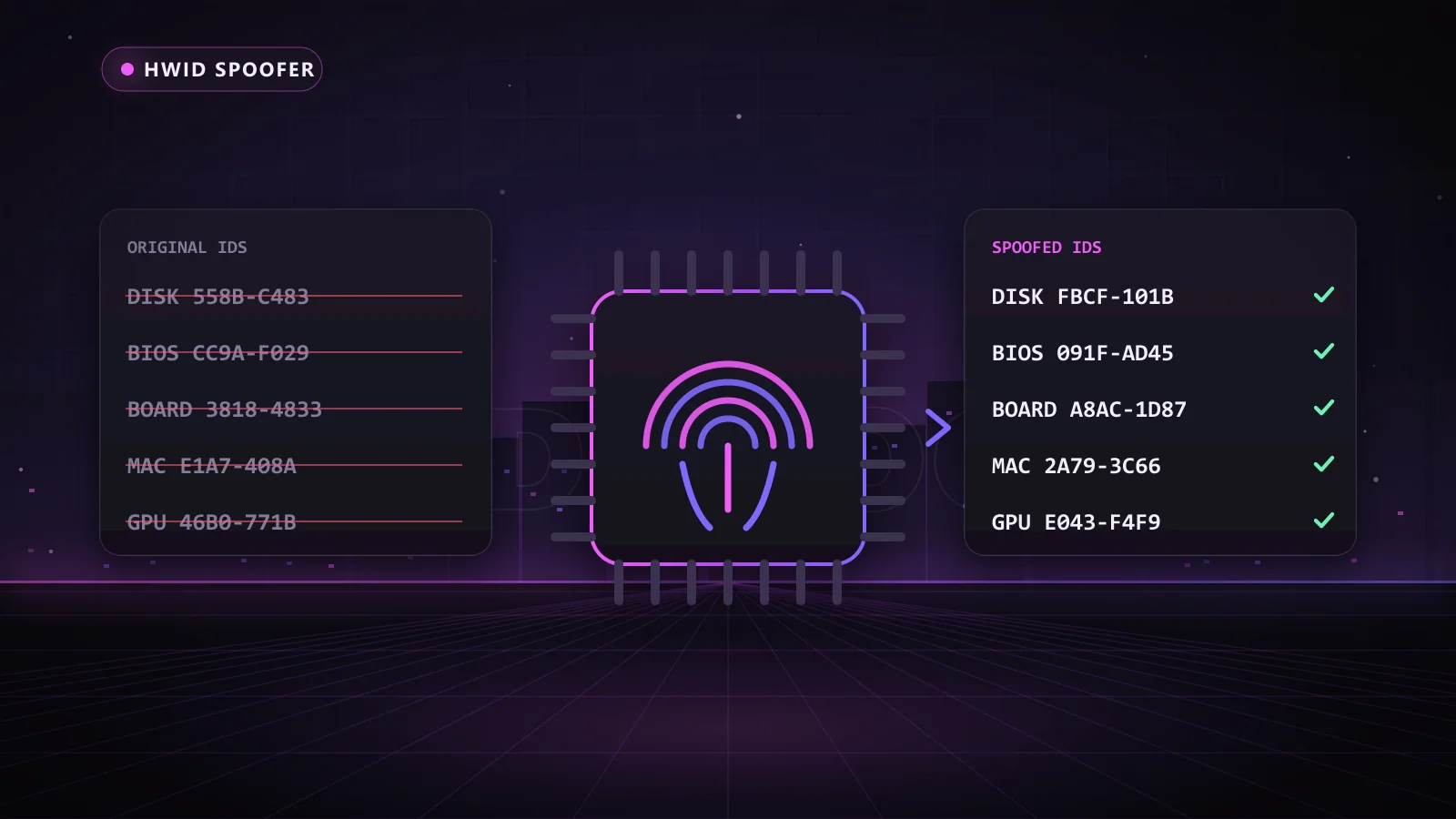
An HWID spoofer is a tool that changes the hardware identifiers your PC reports to games and anti-cheat. Instead of your real disk serials, motherboard IDs and network addresses, the game sees a fresh set of values. To the game, it looks like a different computer.
That matters because many games do not just ban accounts. They ban hardware. If your PC has been flagged, a new account on the same machine can be caught almost immediately. A hardware spoofer breaks that link and gets you back in the game. This guide explains which IDs games read, what spoofers change, the difference between temporary and permanent spoofing, and which Chams spoofer is right for you.
Key Takeaways
- Your PC's hardware IDs include disk serials, motherboard and BIOS identifiers, network adapter addresses and more.
- Games and anti-cheats collect these IDs to recognize your machine across accounts.
- Temporary spoofers change reported IDs until you reboot; permanent spoofers change them at the source.
- A spoofer protects your hardware identity; it does not restore a banned account or change how you play.
- Chams offers three spoofers: the HWID Spoofer, the Reported.lol Spoofer and the Novex Permanent Spoofer.
What Is an HWID?
HWID is short for hardware ID. It is not a single number. It is a collection of identifiers that, together, describe your PC. Each component reports some kind of serial number or unique value, and software can combine them into a fingerprint of your machine.
Want to see your own? Our guide on how to check your HWID walks you through finding each identifier in Windows.
Which Hardware IDs Do Games Collect?
| Identifier | Where it comes from | How hard to change |
|---|---|---|
| Disk serial numbers | Your SSDs and hard drives | Easy to spoof temporarily |
| Motherboard and BIOS (SMBIOS) IDs | Your motherboard's firmware | Temporary spoofing, or a BIOS flash for permanent change |
| MAC address | Your network adapter | Easy to change |
| GPU and monitor identifiers | Graphics card and display | Depends on the spoofer |
| Windows install IDs | Registry and system values | Changed by cleaning or reinstalling |
| TPM identifiers | The security chip on your board or CPU | The hardest; tied to hardware |
Different anti-cheats read different combinations. That is why spoofers list the games and anti-cheats they support, and why matching the spoofer to your game matters.
What Does an HWID Spoofer Change?
A spoofer intercepts the values your PC reports and replaces them with new ones. When the game or anti-cheat asks for your disk serial or motherboard ID, it receives the spoofed value instead of the real one.
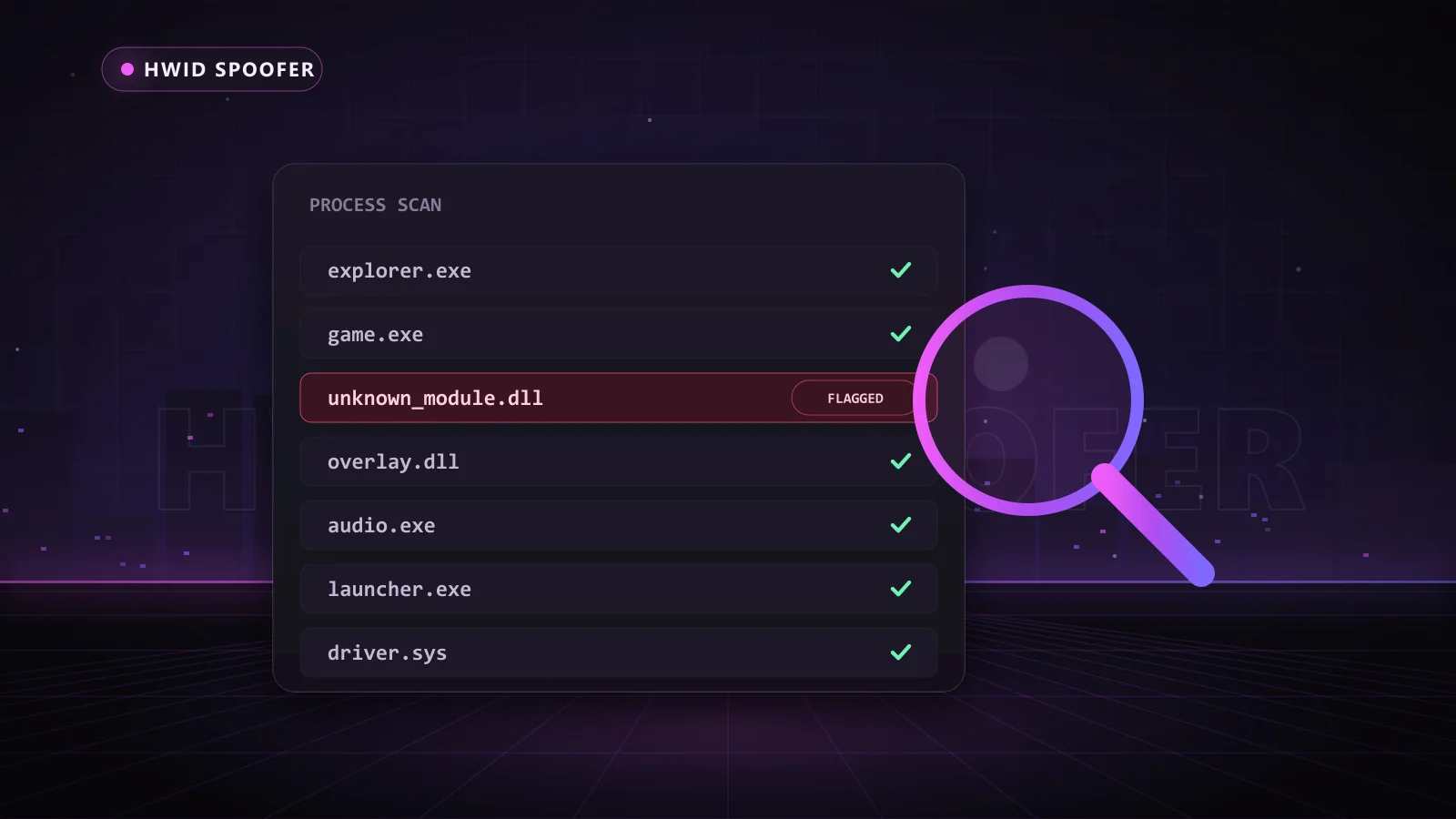
Good spoofers also clean up the traces that link your old identity to your new one. Games leave files, registry entries and cached data behind, and those can tie a new account back to an old ban. That is why a built-in cleaner, like the one in the Reported.lol Spoofer, is such a useful feature.
Temporary vs Permanent Spoofing
Temporary spoofers
A temporary spoofer changes the reported IDs while your PC is running. When you reboot, your real IDs come back, and you run the spoofer again before playing. Temporary spoofers are quick to use, require no hardware changes and are easy to stop using.
Permanent spoofers
A permanent spoofer changes identifiers at the source, so the new values stay after a reboot. This takes more setup but means you do not need to run anything before each session.
| Spoofer | Type | Key lengths | Highlights |
|---|---|---|---|
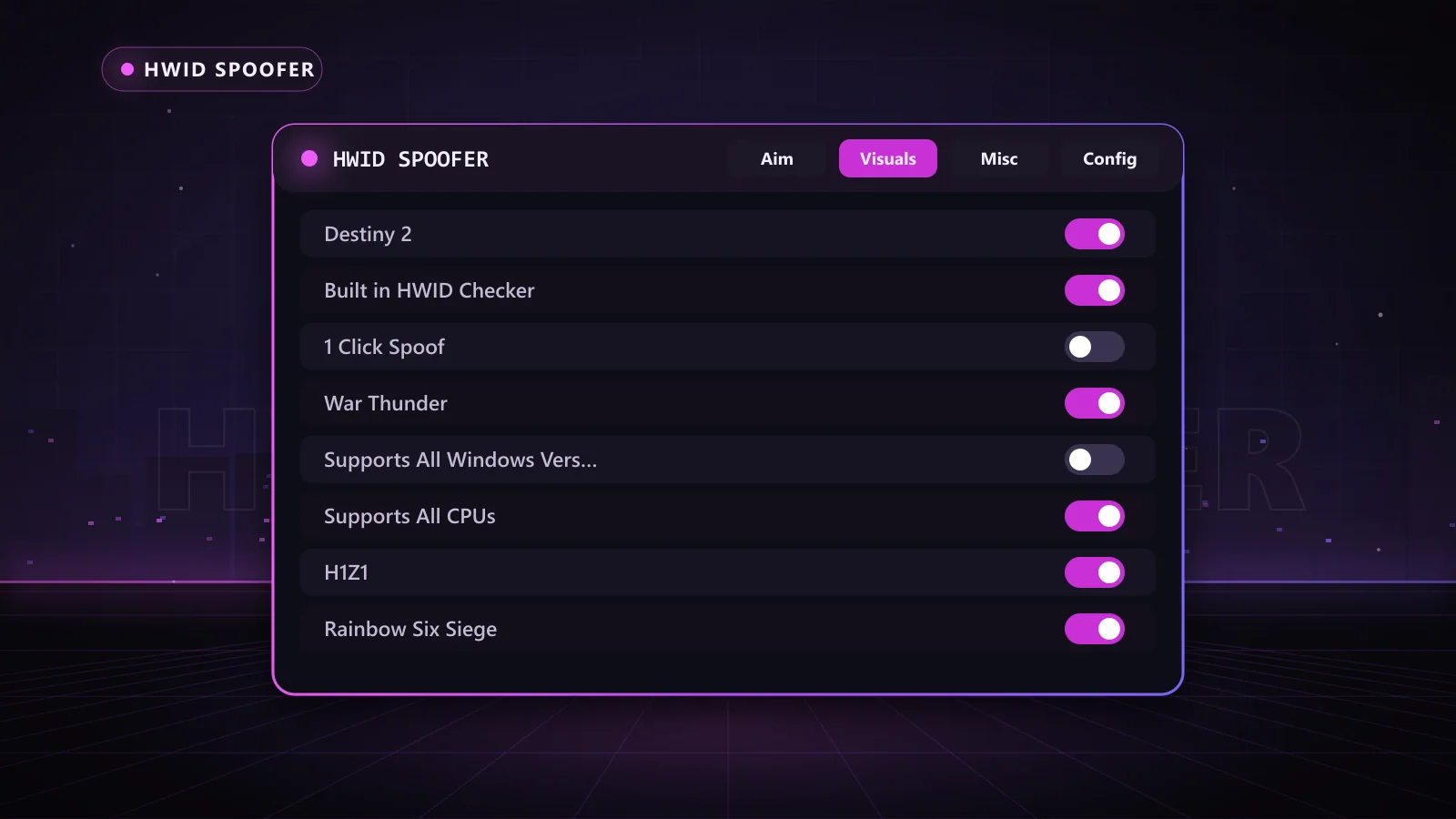
| HWID Spoofer | Temporary | 1 Day, 1 Week, 1 Month, Lifetime | All Windows versions, all CPUs, 1-click spoof, built-in HWID checker |
| Reported.lol Spoofer | Temporary | 15 Day, 30 Day, 90 Day, 365 Day | Intel and AMD, Windows 10 and 11, built-in cleaner |
| Novex Permanent Spoofer | Permanent | One Time, Lifetime | EAC (including all Fortnite anti-cheats), BattlEye and Ricochet; all Windows versions including 25H2 |
Which Chams Spoofer Fits You?
Want the simplest option? The Chams HWID Spoofer supports all Windows versions and all CPUs, spoofs in one click and includes a built-in HWID checker so you can confirm your new IDs. Supported games include Rainbow Six Siege, Destiny 2, ARK: Survival Evolved, Arma 3, War Thunder, PlanetSide 2, H1Z1 (now Z1 Battle Royale) and Conan Exiles. Grab a 1 Day key to try it, or go Lifetime.
Playing Fortnite, Apex or Battlefield? The Reported.lol Spoofer supports Intel and AMD on Windows 10 and 11 and includes a built-in cleaner. Supported games include Apex Legends, Battlebit, Battlefield, Dead by Daylight, Fortnite, Fortnite tournaments, Hell Let Loose, Insurgency: Sandstorm and New World.
Want it done once? The Novex Permanent Spoofer covers Easy Anti-Cheat (including all Fortnite anti-cheats), BattlEye and Ricochet. It requires a RAID0 or RAID-capable drive setup, a Windows reinstall, an 8GB USB drive and a BIOS flash, and supports all motherboards except HP, Dell and Alienware. It is the most involved setup, and the payoff is a change that stays in place.
When Players Use a Hardware Spoofer
- After a hardware ban: to play again on a new account without the new account being linked to the flagged PC. Learn more in our guide to how HWID bans work.
- As an extra layer: many players run a spoofer alongside their cheat so a fresh account is not tied to their real hardware.
- With second-hand hardware: used parts can carry a history you know nothing about.
- Alongside DMA: DMA keeps the cheat off your gaming PC, and a spoofer protects that PC's identity too.
What a Spoofer Cannot Do
- It does not restore a banned account. You will need a new one.
- It does not change how you play. Reports and gameplay reviews still look at your behavior.
- It does not cover every game. Always check the supported list.
- It works best with a clean start: new account, cleaned traces and, where needed, a different network.
Check the Chams status page for the live status of each spoofer before you play, especially after a game or anti-cheat update.
How to Use a Spoofer the Right Way
A spoofer works best as part of a clean routine. Players who get the most out of one follow the same basic steps:
- Close the game and its launcher completely before you spoof, so nothing is holding on to your old IDs.
- Clean old traces: use the built-in cleaner where your spoofer has one, so leftover files and registry entries do not link you to an old account.
- Spoof, then verify: with the Chams one-click spoofer, the built-in HWID checker shows you the new values before you launch anything.
- Use a fresh account: a spoofer protects your hardware identity, so pair it with an account that has no ban history.
- Repeat after each reboot if you use a temporary spoofer. Permanent spoofers do not need this step.
Follow this order every time and you avoid the most common mistake: launching the game once with your real IDs and undoing the whole point of spoofing.
Are Free Spoofers Worth the Gamble?
Free spoofers are everywhere, and they are tempting. The problem is that a free tool is usually old, rarely updated and widely shared, which makes it one of the first things anti-cheat learns to recognize. Some free downloads also bundle unwanted software that you really do not want running with system-level access.
A paid spoofer from a store with a public status page and real support is a much better bet. You know when it is updated, you can check its live status, and someone can help you when something goes wrong.
Spoofer vs Replacing Hardware
The alternative to spoofing is replacing the components that were flagged: drives, sometimes the motherboard, and anything else the game tracks. That is expensive and slow, and you may not know which parts were recorded. A spoofer gets you playing again for the price of a key and a few minutes of setup.
Why Choose Chams
- Three spoofers for different needs: one-click temporary, temporary with cleaner, and permanent.
- Flexible key lengths: from 1 Day up to Lifetime, delivered automatically right after payment.
- Live status page: see the current state of every spoofer before you play.
- Real support: help with setup, especially for the permanent spoofer.
- Cheats and DMA too: pair a spoofer with products for many games or a full DMA rig.
Frequently Asked Questions
What does an HWID spoofer do?
It changes the hardware identifiers your PC reports, so games see a different machine.
Is a hardware spoofer the same as an HWID changer?
The terms are used interchangeably. Both describe tools that change or mask your hardware IDs.
Is a permanent spoofer better than a temporary one?
Not always. Permanent spoofers stay in place after a reboot but need more setup. Temporary spoofers are quick and flexible.
Does it work for Fortnite?
Yes. The Reported.lol Spoofer lists Fortnite and Fortnite tournaments, and the Novex Permanent Spoofer covers all Fortnite anti-cheats.
Can a spoofer change TPM IDs?
TPM identifiers are tied to a hardware chip and are the hardest to change. Check each product's feature list and ask support before buying if your game relies on TPM.
Get Back in the Game With Chams
A hardware ban does not have to be the end. Pick the spoofer that fits your games on the HWID spoofer page, or start right now with the one-click Chams HWID Spoofer.