

Valorant ranks are the nine competitive tiers Riot uses to measure your skill: Iron, Bronze, Silver, Gold, Platinum, Diamond, Ascendant, Immortal and Radiant. Every tier except Radiant has three divisions, which gives 25 ranks in total, and you move through them by gaining or losing Rank Rating (RR) after every match.
Under the badge sits a hidden matchmaking rating (MMR). It decides who you face and how much RR each result is worth, and it explains most of the strange moments in ranked, like a tiny gain after a clean win or a heavy loss after a close defeat.
This guide from the Chams team covers the full ladder as it stands at the time of writing, how RR and MMR interact, how placements and the leaderboard work, and the habits and tools that help players climb.
Key Takeaways
- There are nine tiers and 25 Valorant ranks, from Iron 1 up to Radiant.
- Each division takes 100 RR to clear; wins add RR and losses remove it.
- Hidden MMR controls your opponents and the size of your RR gains and losses.
- Immortal and Radiant are tied to a regional leaderboard rather than a fixed RR target.
- Better information wins rounds: crosshair placement, utility and awareness matter at every tier.
Every Valorant Rank in Order
The competitive ladder starts at Iron and ends at Radiant. Here is every tier and what it usually looks like in practice.
| Tier | Divisions | What it usually means |
|---|---|---|
| Iron | Iron 1, 2, 3 | New to tactical shooters and still learning the basics |
| Bronze | Bronze 1, 2, 3 | Learning crosshair placement and agent abilities |
| Silver | Silver 1, 2, 3 | Good aim moments but inconsistent fundamentals |
| Gold | Gold 1, 2, 3 | Comfortable mechanics, improving utility and trades |
| Platinum | Platinum 1, 2, 3 | Solid fundamentals and the start of real team play |
| Diamond | Diamond 1, 2, 3 | Strong aim, game sense and consistent utility |
| Ascendant | Ascendant 1, 2, 3 | Highly skilled players with sharp coordination |
| Immortal | Immortal 1, 2, 3 | Top players in a region, placed on the leaderboard |
| Radiant | Single rank | The very top of each regional leaderboard |
Ascendant was added later in the game's life, between Diamond and Immortal, to spread out the upper part of the ladder. Any guide that lists only eight tiers is out of date.
How Rank Rating (RR) Works
Rank Rating is the visible 0 to 100 number under your badge. Reach 100 and you promote to the next division. Drop below 0 after a loss and you can be demoted.
A win adds a chunk of RR, a loss removes some, and a draw gives a small amount based on how you played. The exact numbers change match to match because they depend on your hidden MMR and, in lower and middle tiers, on your individual performance.
Riot has said that personal performance can nudge RR at lower and middle ranks, while at the top it is mostly about the result. Either way, winning rounds and matches is what moves you most, which is why every edge in information and accuracy pays off over a full act.
Hidden MMR: The Number That Really Decides Your Climb
MMR is the internal skill estimate the game uses for matchmaking. You cannot see it, but you can see its effects in every RR update.
- MMR above your rank: bigger gains for wins and smaller losses, because the system thinks you belong higher.
- MMR below your rank: smaller gains and bigger losses, because the system expects you to drop.
- MMR close to your rank: gains and losses stay fairly even.
This is why two friends with the same badge can see very different RR after the same match. The way out is consistent winning: string together good results and your MMR pulls your Valorant rank up with it.
Unlocking Competitive and Placement Matches
Before you get a rank, you need to unlock Competitive. Riot uses an account level threshold, which has been level 20 for a long time, to keep brand new accounts out of ranked.
New players then play a short set of placement matches before their first rank appears, five at the time of writing. Placements look at wins and overall performance, and first ranks can be held back a little so new accounts do not start too high.
When a new episode or act starts, returning players may need a placement match or face a rank adjustment. Riot has changed resets several times, so read the patch notes for the current act rather than relying on an older guide.
Rank Distribution: Where Most Players Sit
Riot does not publish an official live rank distribution, and third-party trackers only see players who use them. Those trackers consistently suggest most players sit somewhere around Silver and Gold, with each tier above Platinum getting noticeably smaller.
Immortal and Radiant are a small slice of the player base. Treat any exact percentages you find online as estimates, since they shift every act as Riot tweaks matchmaking and resets.
How Immortal and Radiant Work
Once you reach Immortal, you appear on the regional leaderboard. Your RR keeps climbing past 100 instead of resetting, and your position on that board decides whether you are Immortal 1, 2, 3 or Radiant.
Radiant is a fixed number of leaderboard spots in each region. That means you can lose it without a single bad match if other players climb past you, and the RR needed to hold it moves throughout the act.
Party rules also tighten at the top. Rank limits for groups get stricter in the higher tiers, and wide-spread five-stacks usually earn reduced RR. Check the in-game party rules for current limits.
How to Climb Valorant Ranks Faster
There is no single trick, but these habits help at almost every level of the ladder:
- Master two or three agents. One controller, one initiator and one duelist played well beats every agent played badly.
- Fix crosshair placement first. Holding head height on common angles wins more duels than wild flicks.
- Use utility for teammates. A well-timed flash or smoke wins rounds that raw aim cannot.
- Call positions. Short callouts about enemies and the spike make a real difference in solo queue.
- Stop after two losses in a row. Tilted games drag your MMR down.
- Review your deaths. A few rounds of replay show patterns like wide peeks and late rotations.
How Chams Tools Help You Climb
Most lost rounds in Valorant come down to two things: not knowing where the enemy is, and losing the first duel. That is exactly where the Chams Valorant lineup is built to help, whether you want stronger awareness, cleaner aim or both.
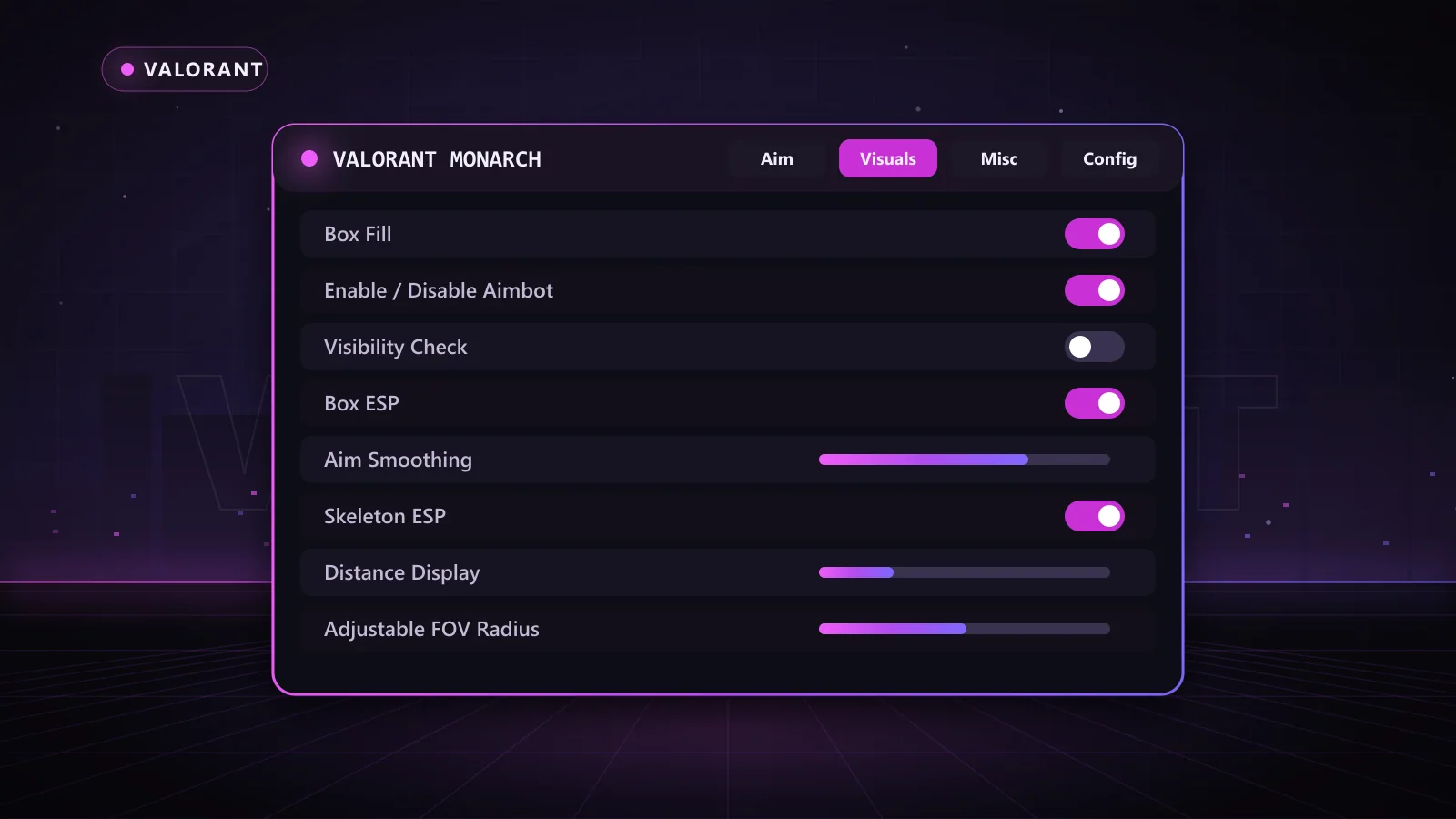
- Valorant Monarch is our best-selling Valorant product. It pairs a mouse and memory aimbot with adjustable FOV, aim smoothing, raycast visibility checks and bone selection from head to pelvis, plus box ESP, skeleton ESP, health bars and distance display so you see every threat before you peek. Keys come in 1 Day, 1 Week and 1 Month.
- Valorant Hero focuses on a smooth aimbot with FOV, stickiness, bone and visible checks, alongside detailed player ESP with health and shield bars. It is the option with a Lifetime key for players who know Valorant is their main game.
- Valorant RKX DMA is built for DMA setups, with raytrace-based triggerbot, variable X/Y smoothing, per-weapon settings and a high-performance DMA overlay with skeleton and bone joints.
Valorant runs Riot Vanguard, a kernel-level anti-cheat, and our products are built and updated with that in mind. Before every session, check the live status page for the current state of each product, and read our Riot Vanguard guide if you want to understand how the system works. Many players also add the Chams HWID Spoofer as an extra layer.
Want the full comparison of ESP, aimbot and DMA options in one place? Head to the Valorant cheats page and pick the product and key length that fits how often you queue.
Frequently Asked Questions
How many Valorant ranks are there?
There are 25 at the time of writing. Eight tiers, from Iron to Immortal, have three divisions each, and Radiant is a single rank at the top.
What is the most common rank in Valorant?
Riot does not publish official numbers, but third-party trackers consistently put most players around Silver and Gold, with each higher tier getting smaller.
How much RR do you need to rank up?
You need 100 RR to promote from one division to the next. From Immortal upward, RR keeps building and your leaderboard position decides your rank instead.
Why do I gain so little RR for a win?
Small gains usually mean your hidden MMR is below your current rank. Keep winning and the gains should grow as your MMR catches up.
Do you get RR back if you lose to a cheater?
Riot has introduced RR restoration, which returns some or all lost RR when a player in your match is later banned. At the time of writing it is applied automatically.
Start Your Climb With the Right Edge
Valorant ranks look simple on the surface, but hidden MMR is what really moves you. Win more rounds, see threats first and take cleaner duels, and your badge, RR and matchmaking all move in the right direction together.
Ready to see more and miss less? Grab a day key for Valorant Monarch to test it on your own setup, or compare the whole lineup on the Valorant cheats page. Keys are delivered automatically right after payment, so you can be in your next ranked match in minutes.