
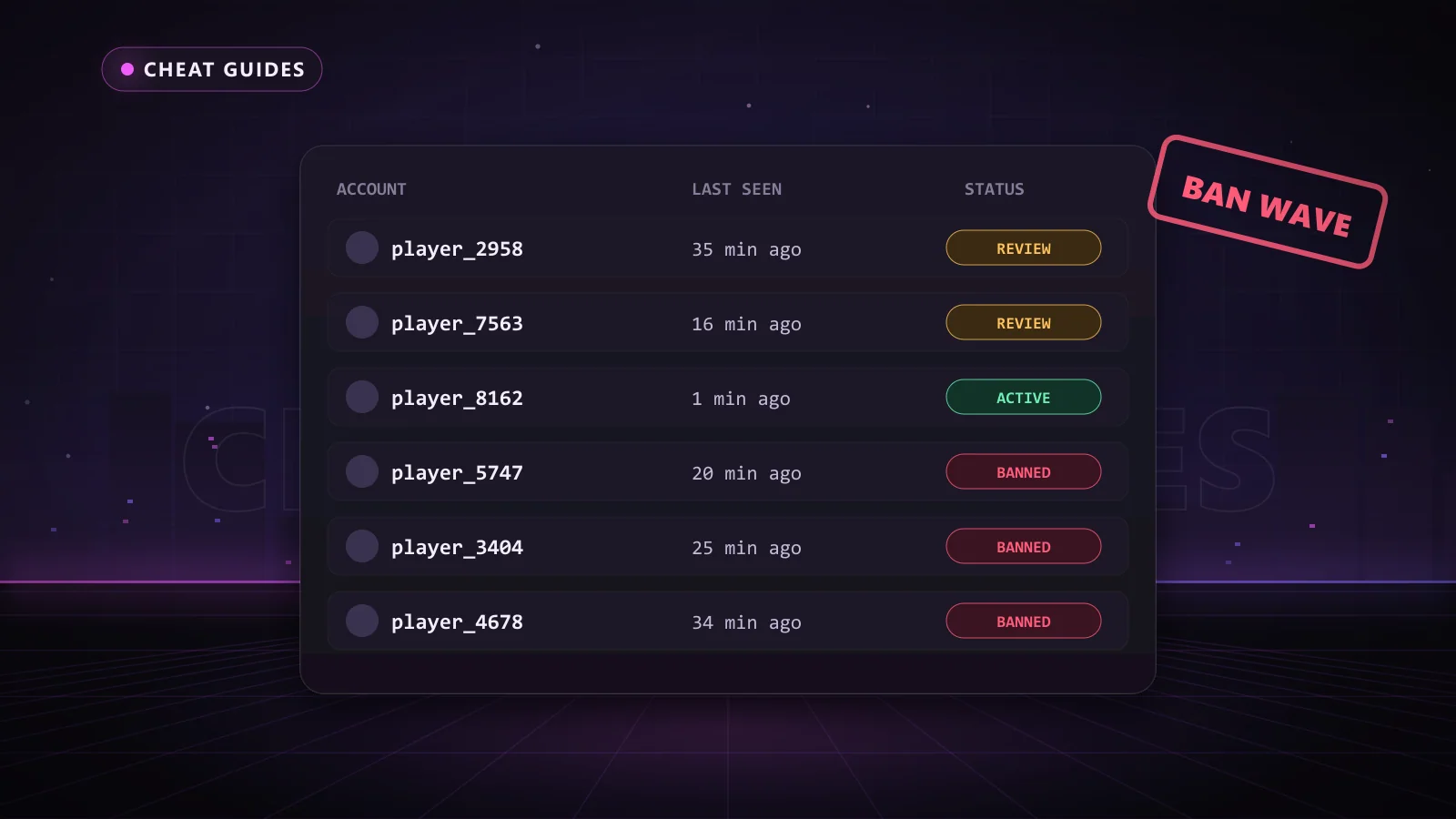
A ban wave is the moment a studio flips the switch and bans a large batch of accounts at once, often days or weeks after the activity that triggered them. One morning a forum fills up with posts from players who logged in to a ban message, and everyone asks the same thing: why now, and why all at once?
This guide explains how ban waves work from the inside: why anti-cheat teams delay bans, why they batch them, how players notice a wave coming, and what a good provider does to keep you informed. As a store that lives and breathes this space, we see the patterns up close, and we will show you how the Chams status page, HWID spoofers and DMA hardware fit into staying ahead.
Key Takeaways
- A wave is a batch of bans issued together, usually after a delay, rather than banning each account the moment it is flagged.
- Studios delay bans to hide which detection caught a tool, to collect more evidence and to hit as many users of one tool as possible.
- Waves often follow a game or anti-cheat update, a new detection or a big competitive event.
- Hardware bans often ride along with account bans, which is why HWID spoofers are so popular.
- A live status page, frequent updates and the right setup are the best ways to stay informed. No provider can promise you will never be caught.
What Is a Ban Wave?
When anti-cheat software flags an account, the studio has a choice. It can ban that account straight away, or it can quietly mark it and wait. A wave is what happens when a studio chooses to wait, collects a large list of flagged accounts and then bans them all on the same day.
From the outside, the wave looks sudden. In reality, the detection that caused it may have been running silently for weeks. That delay is the whole point.
Why Studios Delay Bans
Instant bans give tool developers an easy feedback loop. If an account is banned the minute a tool is launched, the developer knows exactly what was detected and can fix it within hours. Delayed bans break that loop. Here is why anti-cheat teams like them:
- They hide the detection. When bans arrive weeks later, it is much harder to work out which update, feature or behavior was caught.
- They catch more users. Waiting lets the studio flag everyone using a particular tool before it reacts, instead of only the first few.
- They allow review. Some flags need a human or a second system to confirm, and batching makes that review more efficient.
- They make a statement. A big public wave, often with an announcement, is a strong message to the rest of the player base.
Why Bans Arrive in Batches
Batching is mostly about efficiency and timing. Studios often line up waves with moments that make sense for them:
- After a game or anti-cheat update, when a new detection has had time to collect data.
- Before or after a ranked season or major event, to clean up leaderboards.
- On a regular cycle, such as a periodic sweep that clears accumulated flags.
- Alongside an announcement, when the studio wants to publicize its anti-cheat work.
| Instant ban | Batched wave | |
|---|---|---|
| Timing | Seconds to minutes after detection | Days or weeks after detection |
| Who gets hit | One account at a time | Large groups at once, often users of the same tool |
| Feedback for tool developers | Immediate and obvious | Delayed and harder to trace |
| Typical trigger | Known signature or blatant behavior | New detection that has been gathering data |
| Hardware bans | Sometimes | Often included with the wave |
What Sets Off a Wave
Most waves come from one of a few sources, often combined:
- Signature detection. Anti-cheat learns to recognize a specific tool, driver or piece of code.
- Behavior analysis. Server-side systems look at stats like reaction times, headshot rates and impossible information.
- Player reports. Reports feed review queues, especially in competitive modes.
- Hardware identifiers. Once a PC is linked to a banned account, new accounts on the same hardware can be flagged too. Our guide to HWID bans explains how that works.
How Different Anti-Cheats Handle Waves
Every anti-cheat has its own rhythm, and knowing it helps you read the signs:
- VAC (Counter-Strike 2 and other Valve games). Valve Anti-Cheat has long been known for delayed bans, with accounts flagged quietly and banned later in groups.
- Ricochet (Call of Duty). Activision regularly publicizes enforcement and pairs server-side checks with its kernel-level driver, so big announcements often follow sweeps.
- BattlEye and Easy Anti-Cheat. Used across many titles, including Rainbow Six Siege, PUBG, Rust, Apex Legends and Fortnite. The game publisher usually decides when bans are issued, so timing varies game to game.
- Riot Vanguard (Valorant). A kernel-level system that starts with the PC, which is why hardware-level options such as DMA with matching firmware get so much attention from Valorant players.
Whatever the game, the pattern is the same: detections often run quietly first, and the visible wave comes later. That gap is exactly why a live status page is worth checking before every single session.
How Players Notice a Ban Wave Coming
Waves rarely arrive with no warning at all. Experienced players watch for:
- A sudden spike in ban reports on forums, subreddits and Discord servers.
- Studio announcements about anti-cheat improvements or ban numbers.
- Large game or anti-cheat updates, especially ones that touch kernel drivers.
- Provider status pages switching a product to updating or testing.
That last one is the most useful signal you have, which is why we keep the Chams status page live for every product. Check it before every session, and especially after an update.
How Chams Helps You Stay Ahead
No provider can stop a studio from running a sweep, and anyone who promises otherwise is not being straight with you. What a good provider can do is keep you informed, update quickly and give you options that add layers. Here is how we approach it:
- Live status. Every product has a live status, so you know the current state before you launch.
- Frequent updates. Products are maintained as games and anti-cheats change.
- HWID spoofers. The Chams HWID Spoofer offers one-click spoofing, a built-in HWID checker and support for all Windows versions and CPUs, in 1 Day, 1 Week, 1 Month and Lifetime keys. For a deeper setup, the Novex Permanent Spoofer supports Easy Anti-Cheat, BattlEye and Ricochet.
- DMA hardware. DMA tools read memory from a second PC instead of running on your gaming PC. The Chams DMA 75t Bundle includes the card, your chosen firmware tier, a Makcu input device and a Dichen 6th Gen fuser.
- Custom firmware. The 1:1 Custom FW for EAC, BE and VGK is DNA locked to your card, with full emulated config space and a one-month warranty.
Want an extra layer before the next wave? Pair your product with the Chams HWID Spoofer, or move to DMA with the 75t Bundle. Keys are delivered automatically right after payment.
Smart Habits Between Waves
- Check status before every session. Do not launch a product that is marked as updating.
- Be patient after big updates. Give it time for the product to be confirmed working again.
- Use natural settings. Smoothing, small FOVs and visible checks reduce the behavior signals that feed waves.
- Pick key lengths wisely. Shorter keys make sense around big updates; longer keys suit stable periods.
- Keep your main separate. Many players keep their most valuable account away from any tool.
Why Choose Chams
- Real support that answers questions about updates and status.
- A live status page for every product.
- Frequent updates across 30-plus games.
- HWID spoofer and DMA options in one store.
- Keys delivered automatically right after payment, in day, week, month and lifetime lengths where listed.
Frequently Asked Questions
What is a ban wave in gaming?
It is a large batch of bans issued at the same time, usually after a delay. The studio flags accounts quietly, then bans them together instead of one by one.
Why do games use ban waves instead of instant bans?
Delayed, batched bans hide which detection caught a tool, let studios flag every user of that tool first, and make it harder for developers to fix the problem quickly.
How long after cheating do batched bans hit?
It varies by game and studio. Some waves land days after a detection, others weeks later. There is no fixed schedule you can rely on.
Do these waves include hardware bans?
They often can. Many anti-cheats link bans to hardware identifiers, which is why players use HWID spoofers to start fresh on new accounts.
How can I tell if a wave is coming?
Watch for spikes in ban reports, studio anti-cheat announcements, big updates and provider status changes. The Chams status page shows live status for every product.
Stay Informed, Stay Ahead
Ban waves are part of the landscape, but they are not a mystery once you understand them. Keep an eye on status, use natural settings and add layers where it makes sense. Browse the full HWID spoofer range or start your DMA setup with the Chams DMA 75t Bundle.