
Knowing how to tell if someone is cheating saves you a lot of tilt. Every shooter has that moment: you die, the killcam rolls, and you are not sure whether you just met a cracked player or an aimbot. The difference is usually in the details, such as where their crosshair was before you appeared, how it moved, and whether it reacted to things it could not possibly have seen.
This guide from the Chams team walks through the real signs of aimbot, ESP, triggerbot and silent aim in killcams and replays, the false positives that make good players look suspicious, and what all of this means for how modern tools are tuned. We build and sell these tools, so we know exactly what gives them away and what keeps them looking natural.
Key Takeaways
- One clip is rarely proof. Look for repeated patterns across several rounds or matches.
- Aimbot tells are about movement: instant snaps, perfect tracking and zero recoil.
- ESP tells are about information: pre-aiming, tracking through walls and ignoring decoys.
- Good players produce many of the same signs through sound, map knowledge and game sense.
- Modern tools use smoothing, small FOVs and humanization so aim looks like skill, which is why settings matter so much.
How to Tell if Someone Is Cheating: Start With the Killcam
Killcams are the fastest evidence you get, but they are also imperfect. Most games rebuild the killcam from server data, so it can look slightly different from what the other player actually saw. Before you decide anything, watch for three things:
- Where the crosshair was before you appeared. Was it sitting on your head through a wall, or on a common angle anyone would check?
- How the crosshair moved. Smooth human corrections look different from a robotic snap or a lock that never wavers.
- What they reacted to. Did they respond to a sound or a teammate's call, or to something they had no way of knowing?
If your game has full replays or a demo system, use it. Watching a whole round from the suspect's view tells you far more than a few seconds of killcam.
Signs of an Aimbot
An aimbot reads enemy positions and moves the crosshair for the player. Crude settings are easy to spot. Look for:
- Instant snaps. The crosshair jumps onto a head in a single frame, often from well off target.
- Perfect tracking. The aim stays glued to a strafing or jumping target without overshooting or correcting.
- Locking through smoke or foliage. Shots stay on target even when the player cannot see anything.
- Bone-perfect consistency. Every hit lands on the same body part at every range.
- No recoil. Long sprays that stay pinned to one point with no visible kick.
- Odd crosshair placement afterwards. The aim snaps to the next target before the player turns their head naturally.
The more of these that stack up over several fights, the stronger the case.
Signs of ESP and Wallhacks
ESP shows players through walls, so the tells are about information rather than aim. Our guide on what ESP is in gaming covers the basics. In replays, look for:
- Tracking through walls. The crosshair follows you as you move behind cover, matching your exact path.
- Pre-aiming unusual spots. Not common angles, but the exact off-angle or corner you chose this round.
- Ignoring decoys. They never fall for fake footsteps, utility or a teammate making noise elsewhere.
- Beelining. Walking straight to hidden players, stashes or loot without searching.
- Calm in chaos. Never surprised by a flank, always turning to face the right direction at the right moment.
Other Tells: Triggerbot, Silent Aim and Radar
Some features leave subtler fingerprints:
- Triggerbot fires the moment the crosshair touches a target. Look for shots that happen with inhuman, identical timing as soon as an enemy crosses the crosshair.
- Silent aim lands hits where the visible crosshair is not pointing. Bullets curve into a head while the camera is slightly off.
- Radar is the hardest to see. The player simply rotates and positions as if they always know where everyone is.
| Sign | What it looks like | Could a good player do it? |
|---|---|---|
| Snap to head | Single-frame jump onto the target | Rarely, but flick shots on close targets happen |
| Tracking through walls | Crosshair follows a hidden enemy's path | Partly, by following footsteps |
| Pre-aim on an odd angle | Waiting on the exact spot you picked | Sometimes, through reads and habits |
| Zero recoil | Spray stays on one point | Strong recoil control looks close |
| Identical reaction timing | Shot fires the instant you cross the crosshair | Top players are fast but not perfectly consistent |
| Hits with crosshair off target | Bullets land where the camera is not aiming | Usually killcam desync, not skill |
False Positives: When a Good Player Looks Like a Cheater
Plenty of legit players get reported every day. Before you decide, consider:
- Sound. High-level players use footsteps, reloads and ability sounds to track people through walls very accurately.
- Common angles. Pre-aiming a popular spot is good crosshair placement, not ESP.
- Teammate calls and spotting. Information from a squad or a pinged marker looks like wallhacking from the outside.
- Killcam desync. Replays can show snaps or aim that never happened that way on the player's screen.
- Raw skill. Thousands of hours of aim training produce flicks and tracking that look impossible to most players.
Game-by-Game Tells Worth Knowing
The basics of how to tell if someone is cheating are the same everywhere, but each genre has its own giveaways:
- Tactical shooters like CS2, Valorant and Rainbow Six Siege. Watch for crosshairs that sit on a defender behind a wall or soft cover, and for prefires through smokes on positions nobody called.
- Battle royales like Fortnite, Apex Legends and Warzone. Look for players rotating straight to hidden squads, beaming targets across huge distances, or tracking through foliage and gas.
- Extraction and survival games like Escape from Tarkov, Rust and DayZ. Beelining to loot, stashes or bases, and knowing exactly where a player is hiding inside a building, are the classic signs.
- Milsims like Squad and Hell Let Loose. Repeated long-range kills on moving targets and finding every spawn point without any recon stand out quickly.
In every genre, the strongest signal is consistency. A great player has good and bad rounds; an obvious tool has the same perfect reactions every time.
How to Check Properly
If you want a fair read, watch a full round or match from the suspect's view, look for the same tell repeating, compare their performance across several matches, and note whether their aim gets suspiciously better against hidden targets than visible ones. Then use the game's report tool and let the developer's systems handle it.
What This Means for Modern Tools
Every sign above comes down to one thing: unnatural movement or unnatural information. That is exactly why modern tools focus so heavily on looking like skill. When we pick products for the store, humanization and control options are near the top of the list:
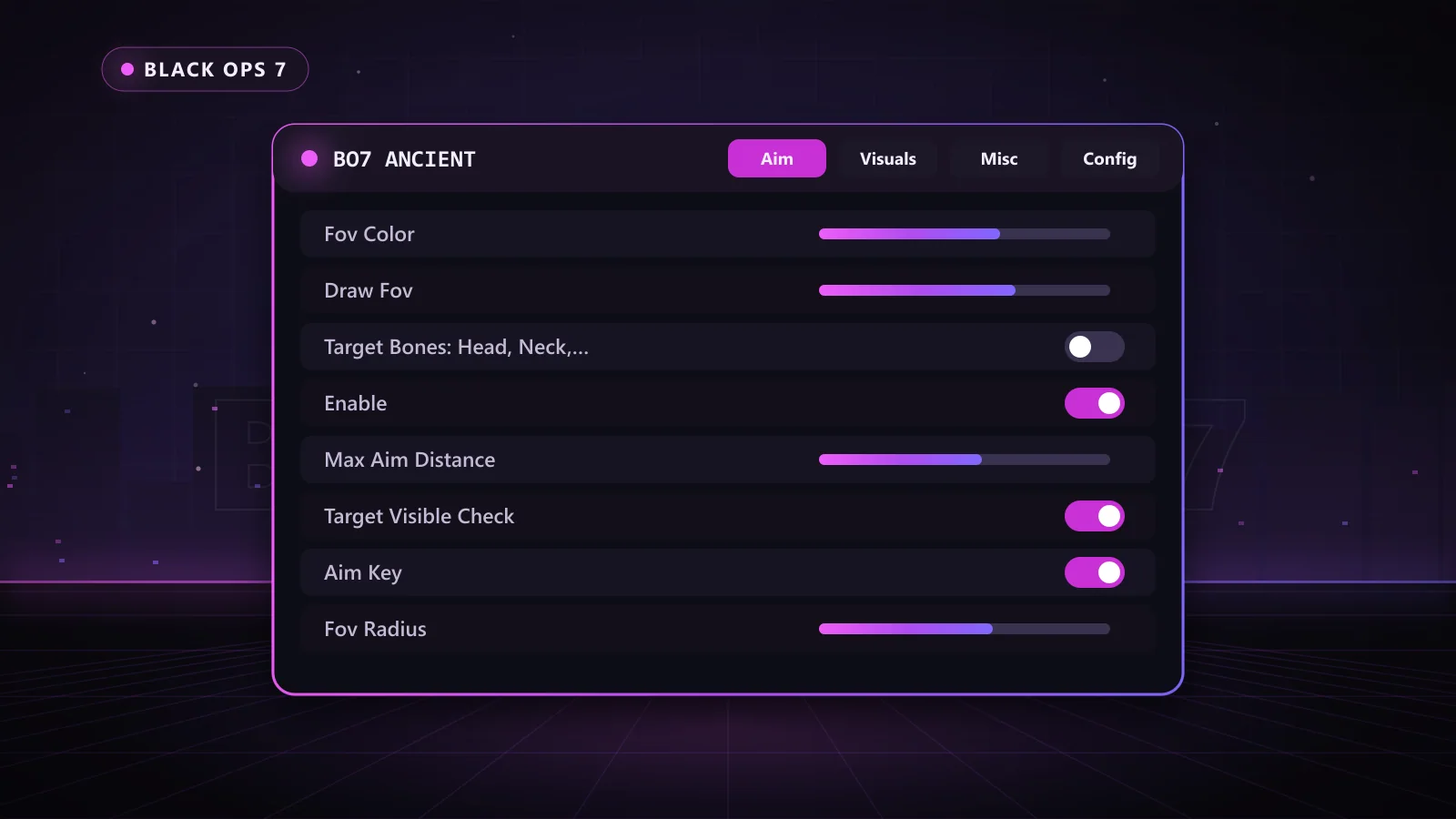
- BO7 Ancient includes a Humanize Aimbot option, smoothing, prediction and a target visible check, so aim moves like a player rather than a script.
- Apex Kernaim offers humanized trajectories, customizable smoothing, dynamic FOV and visibility checks for natural-looking tracking.
- CS2 DMA adds humanization such as reaction time and stand-still aiming, per-weapon overrides and visibility and smoke checks.
The rule of thumb is simple: small FOV, plenty of smoothing, visible checks on, and let ESP inform your decisions instead of snapping your crosshair through walls. Played that way, your gameplay looks like a sharp, well-informed player, which is the whole point.
Want aim that looks like skill? Start with a short key of BO7 Ancient and tune its humanize and smoothing settings to your own style.
Why Choose Chams
- Real support that helps you tune settings for natural-looking play.
- A live status page showing the current state of every product.
- Frequent updates as games and anti-cheats change.
- HWID spoofer and DMA options for players who want an extra layer.
- Keys delivered automatically right after payment, in multiple lengths.
Frequently Asked Questions
How do you tell if someone is cheating in a shooter?
Look for repeated patterns: instant snaps, perfect tracking through smoke, pre-aiming exact off-angles and following players through walls. One clip is rarely enough, so check several rounds.
Can a killcam prove someone is cheating?
Not on its own. Killcams are rebuilt from server data and can show desync. Full replays or demos from the player's view give a much clearer picture.
What is the most common sign of ESP?
Tracking a hidden player through walls and pre-aiming the exact spot they chose, round after round, without any sound or teammate information explaining it.
Why do good players get accused of cheating?
Strong sound awareness, crosshair placement on common angles, teammate calls and killcam desync all produce plays that look suspicious from the outside.
How do modern aimbots look natural?
They use smoothing, small FOVs, visibility checks and humanization features such as reaction delays and humanized trajectories, so aim moves like a skilled player.
Play Sharper With Chams
Now you know how to tell if someone is cheating, and what separates an obvious aimbot from a well-tuned tool. If you want awareness and aim that look like skill, explore Apex Kernaim, BO7 Ancient and CS2 DMA, then read what other players say on our reviews page.